Launch offer — valid today only

📄 Digital book in PDF · read it on your phone or print it

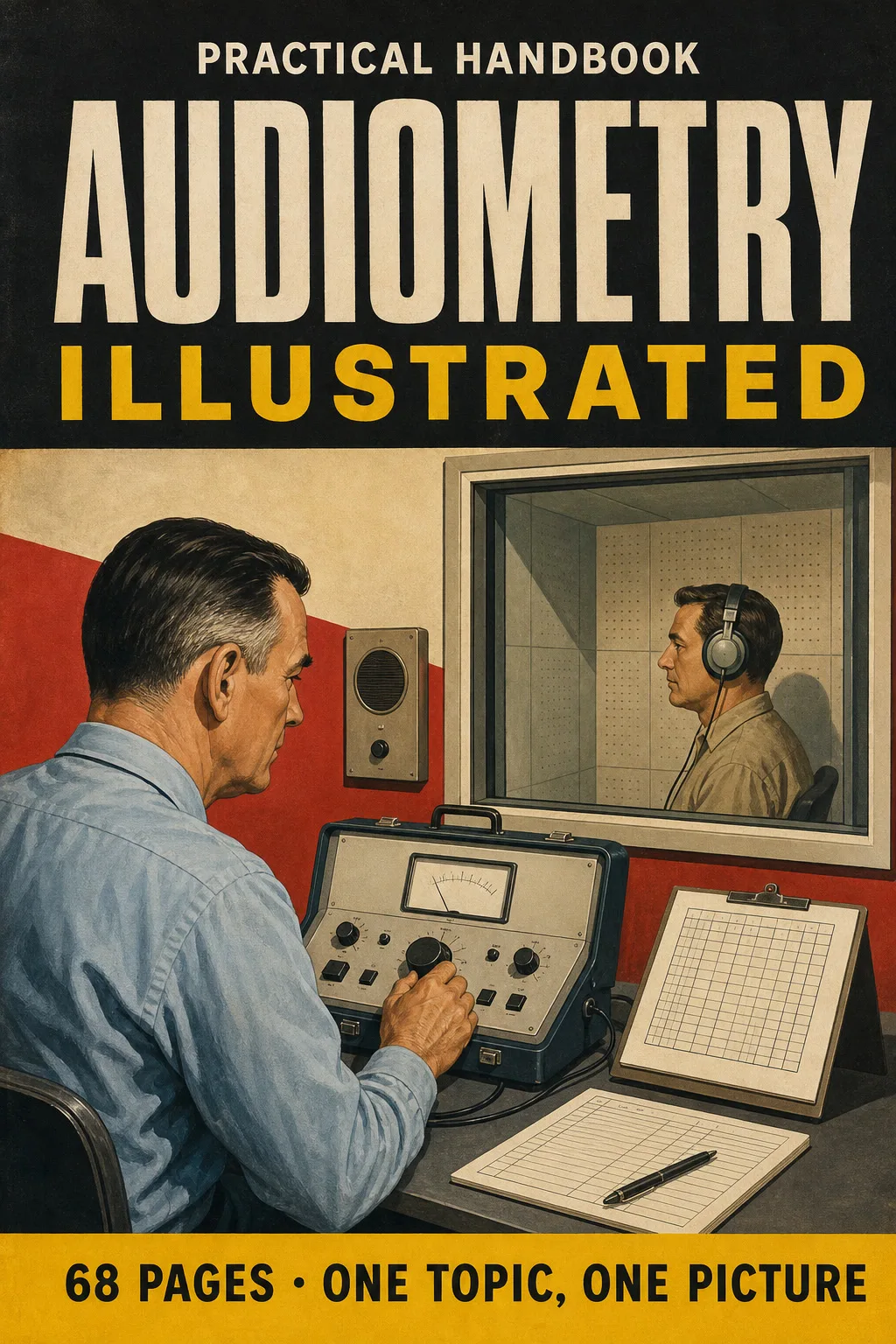
Audiometry and the OSHA Hearing Standard in Drawings Every Test in the Same Order

For the hearing conservationist course and the annual tests at work: the audiometer, down 10 and up 5, masking, audiogram symbols, the 4 kHz notch, baseline vs. annual and when to refer. One topic per page: the drawing first, then what to remember. 68 illustrated pages.

START STUDYING THIS WAY

🔒 Secure checkout · PDF by email · 30-day guarantee

Every topic, its own pageEach test step drawn, with the explanation right beside it
68 illustrated pages9 parts, from the outer ear to one audiogram read in order
Up-to-date sourcesOSHA 29 CFR 1910.95, 29 CFR 1904.10 and ANSI S3.6, S3.1 and S3.21
PDF by emailFormat

Look Inside the Book

Every page has one big drawing and a box with the numbers and steps you need to know:

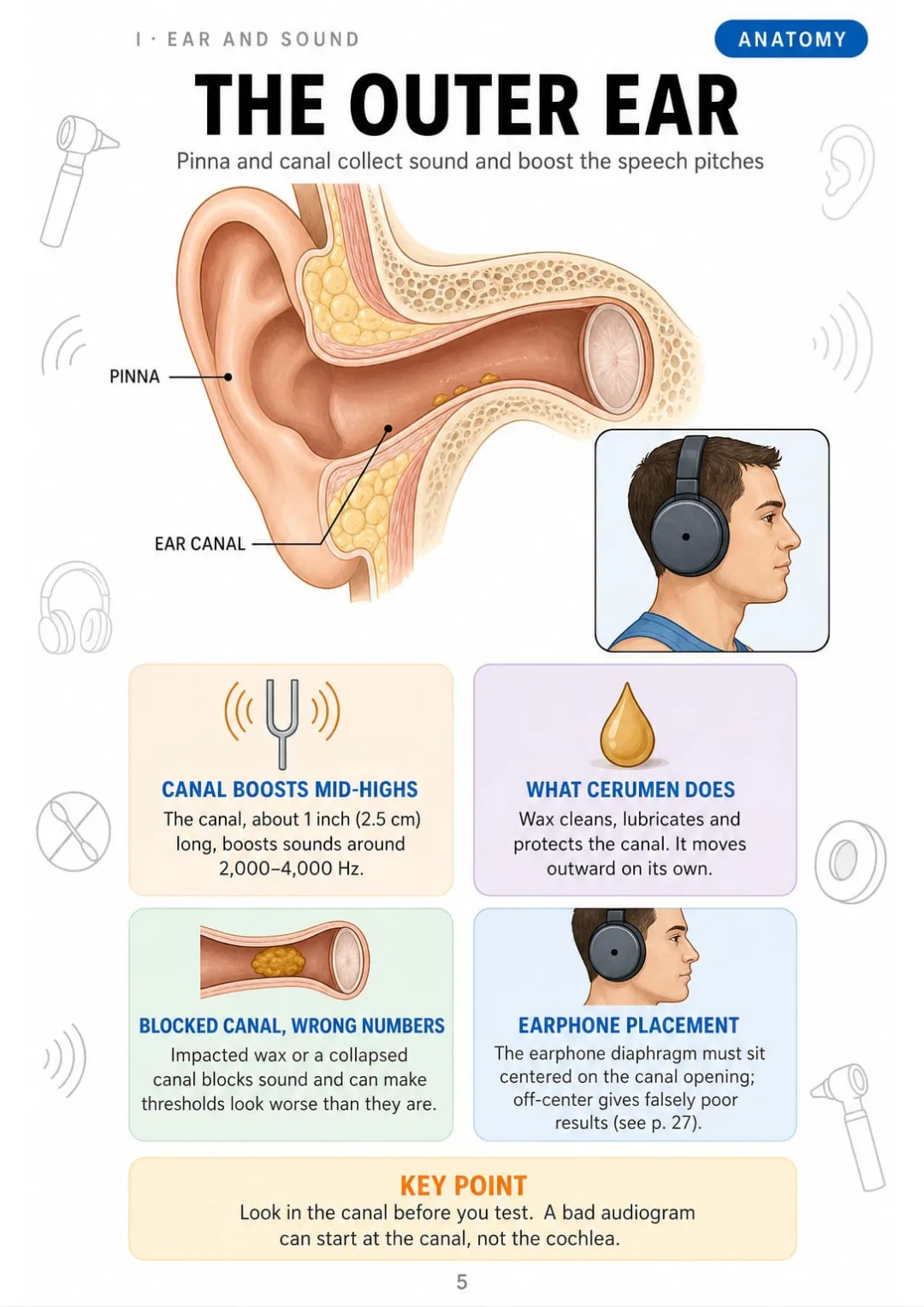
Ear canal about 1 inch long, boosting sounds around 2,000–4,000 Hz
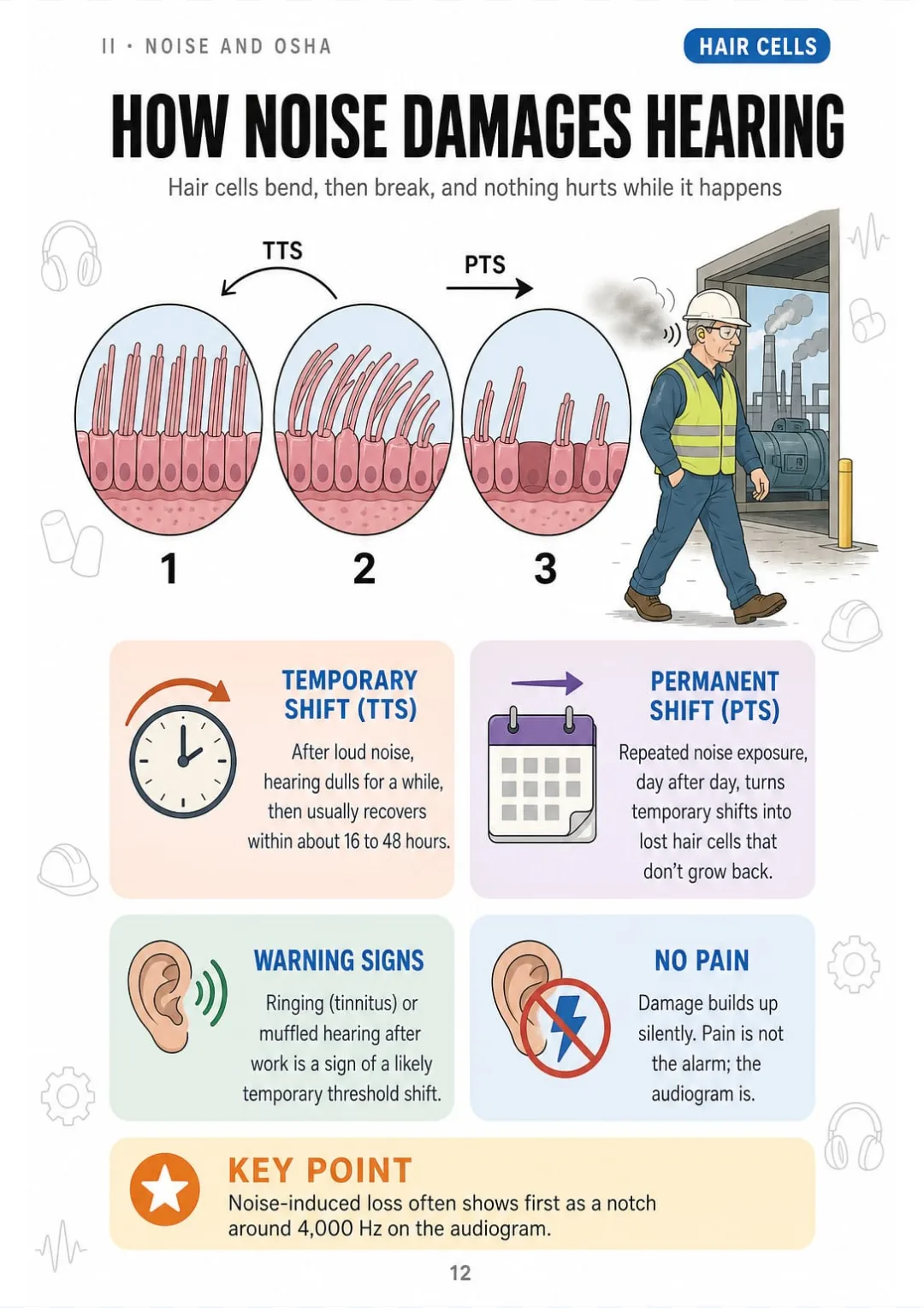
Hair cells drawn healthy, bent and lost: TTS recovers in hours, PTS doesn't.
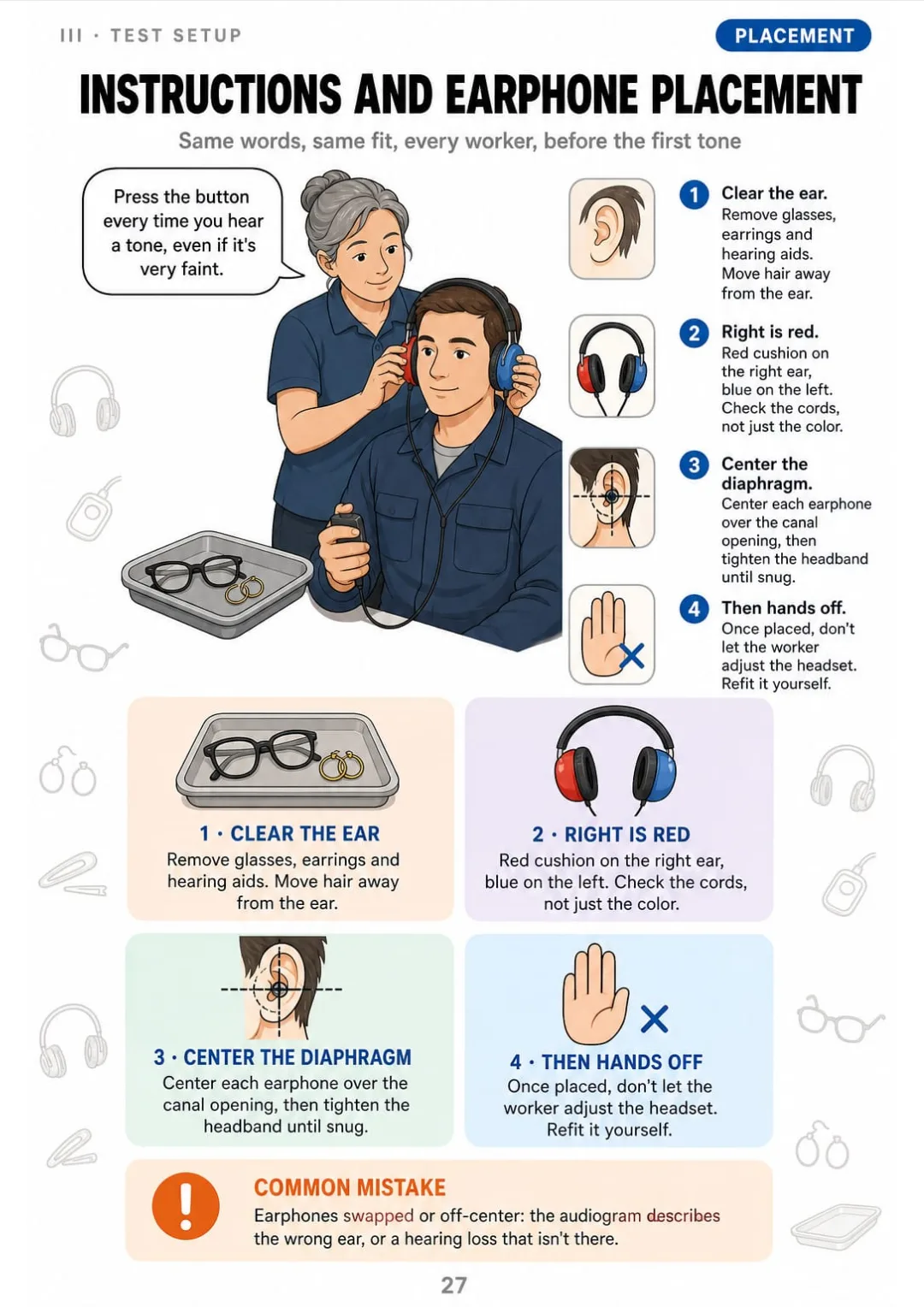
The exact instruction script plus a four-step earphone fit: red right, blue left, centered, snug.
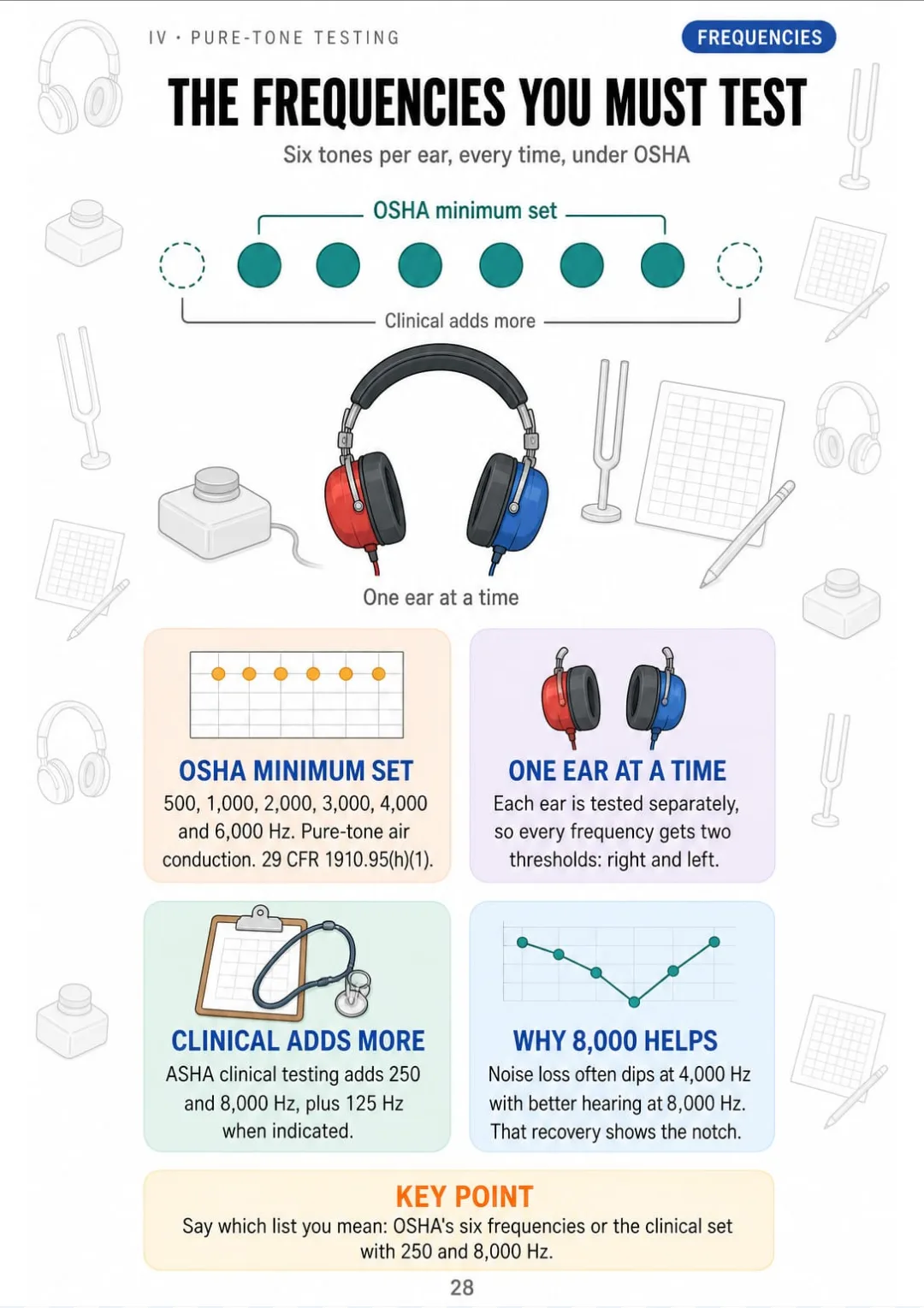
OSHA minimum: 500, 1,000, 2,000, 3,000, 4,000 and 6,000 Hz in each ear.
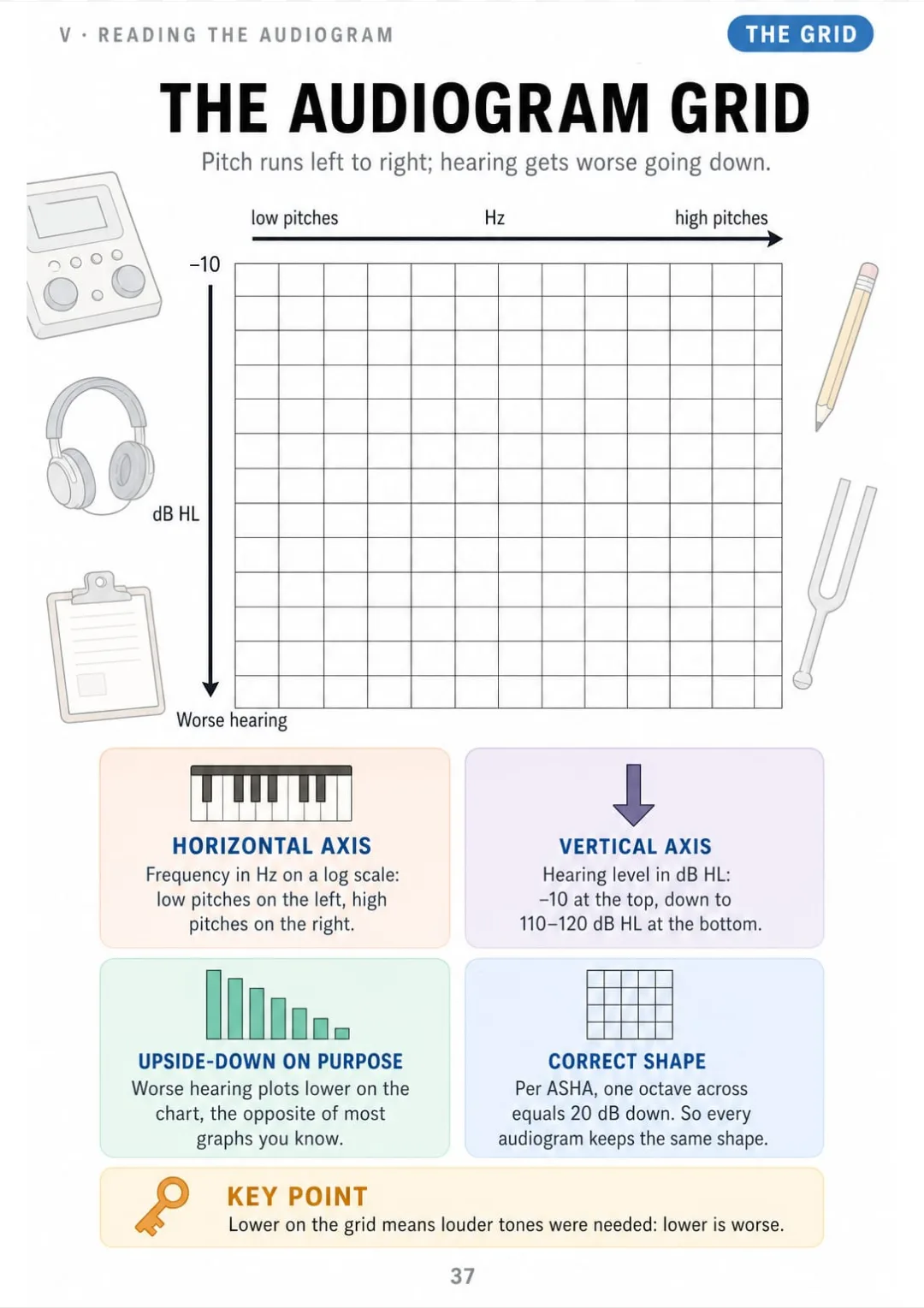
Frequency 250–8,000 Hz left to right · hearing level −10 to 120 dB HL top to bottom
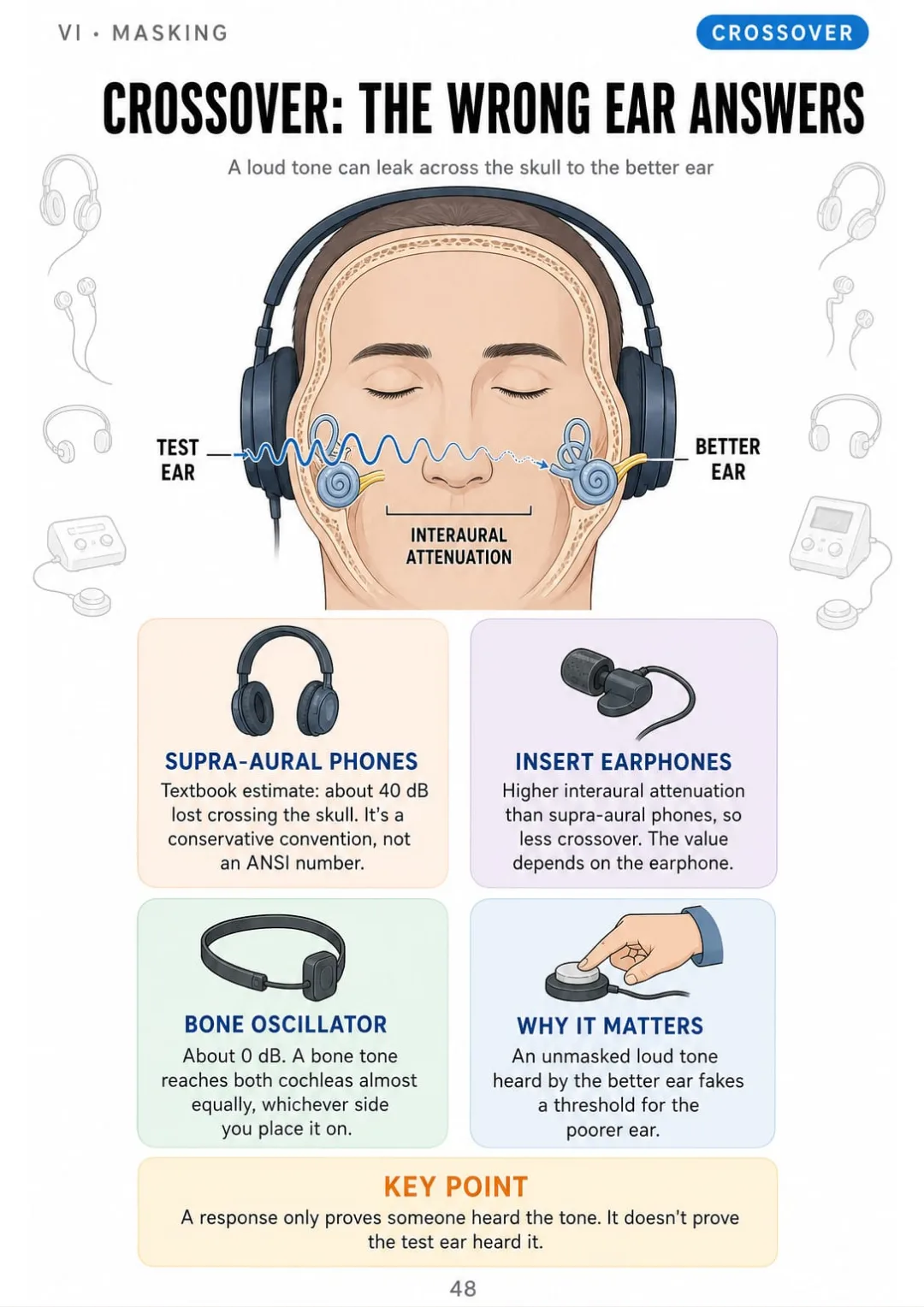
Crossover: about 40 dB with supra-aural phones, more with inserts, about 0 dB for bone
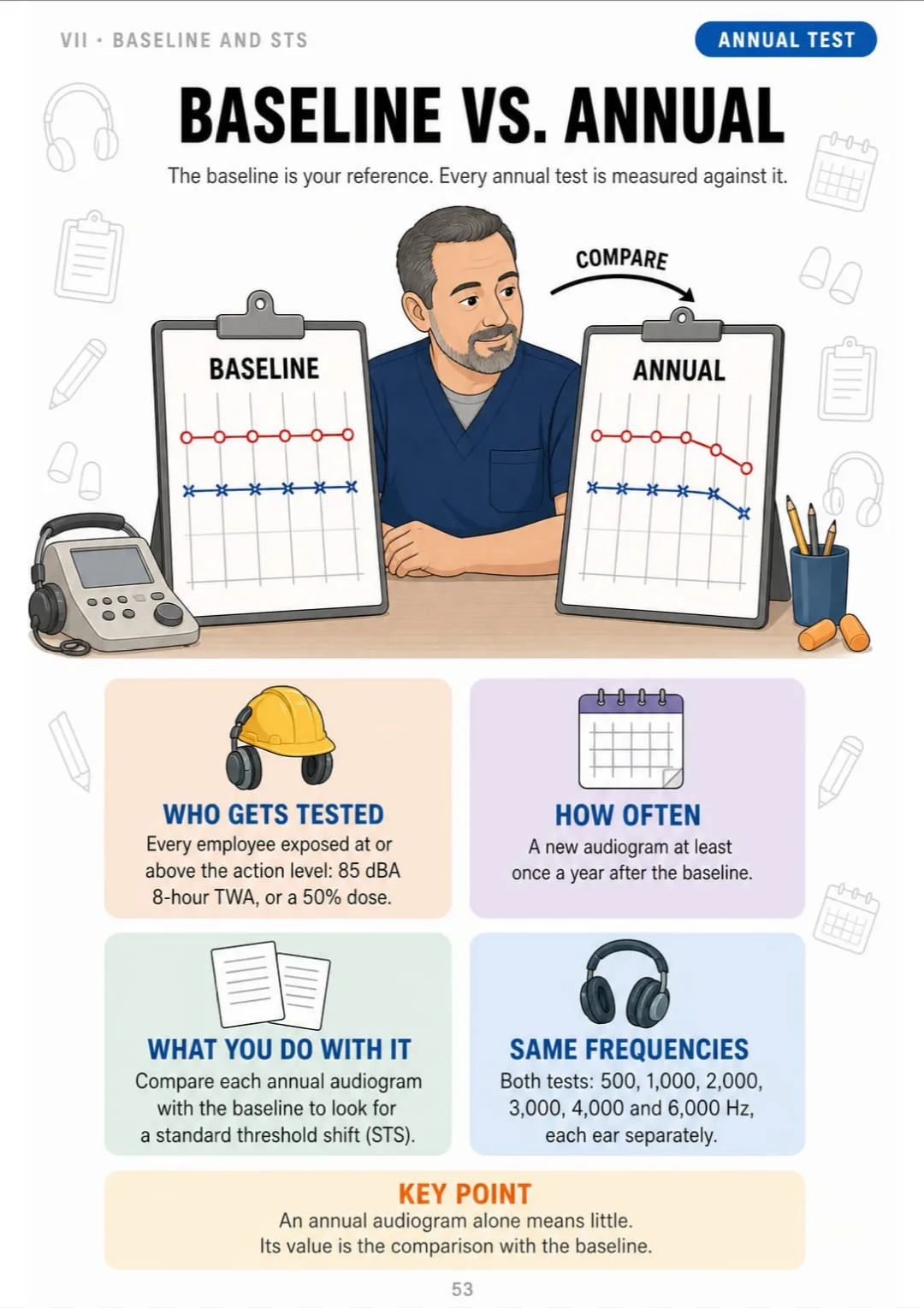
Annual audiogram every year at or above 85 dBA, always compared with the baseline [29 CFR 1910.95(g)(6)–(7)]
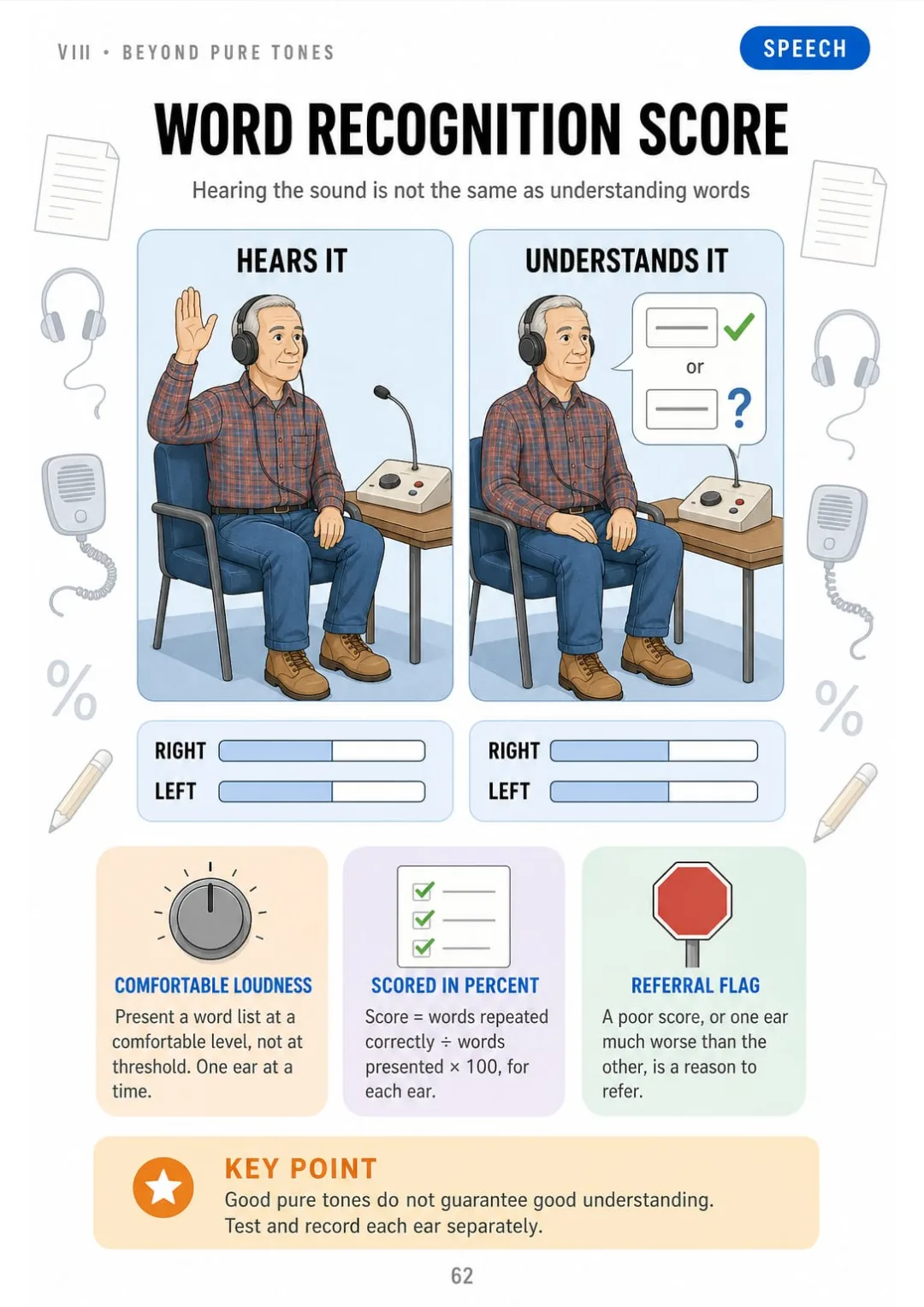
Words at a comfortable level · % correct per ear · one-sided poor score = refer

Swipe to see more →

These are real pages from the book. The table of contents is the full one: 9 parts and 64 topics.

The Problem Isn't You. It's How It Was Explained to You.

Practice session in your course. The instructor is watching you test a classmate at 2,000 Hz. They respond, and you blank: down 10 or up 5? And how many responses make it a threshold?

The course manual explains the threshold search in one long paragraph. Steps inside a sentence, with no order you can see. So with someone watching, you second-guess every tone.

The exact instruction script plus a four-step earphone fit: red right, blue left, centered, snug.

In the book, the pure-tone test is one page: the steps drawn in order, with the numbers next to each one. Down 10 after a response, up 5 after none, threshold at 2 of 3 ascending responses.

The same goes for the 1,000 Hz retest, when to mask, the bone-conduction symbol for each ear and the standard threshold shift.

You look at the panel and know what to press. You run the test without going back to the manual.

COMPARE FOR YOURSELF

The Same Topic, Two Ways to Study It

THIS
  • The manual: line after line
  • Hair cell damage explained only in words
  • You walk into the course still unsure
Exposure to excessive sound pressure levels produces mechanical and metabolic stress on the outer hair cells of the organ of Corti, located along the basilar membrane of the cochlea. Short-term exposure may result in a temporary threshold shift (TTS), characterized by reversible changes in stereocilia stiffness and synaptic function, with recovery typically occurring over a period of hours. Repeated or prolonged exposure can lead to a permanent threshold shift (PTS), in which damaged hair cells are not replaced, producing irreversible sensorineural hearing loss, most often first observed in the 3,000 to 6,000 Hz region.
FOR THIS
  • Healthy, bent and lost hair cells in one drawing
  • TTS and PTS side by side in a box
  • You see it and you get it
Hair cells drawn healthy, bent and lost: TTS recovers in hours, PTS doesn't.
CONTENTS

Take a Look at the 9 Parts and 64 Topics

The ear and sound, noise and the OSHA standard, setting up the test, pure-tone testing, reading the audiogram, masking, baseline and the STS, beyond pure tones, and a test-day toolkit: 68 pages, all illustrated

IThe Ear and Sound · pp. 5-11
  1. The Outer Ear: Where Sound Gets Collected
  2. The Middle Ear: Eardrum and Three Tiny Bones
  3. The Cochlea: High Notes at the Base, Low at the Tip
  4. Two Roads to the Cochlea: Air and Bone
  5. Frequency in Hertz: The Pitch Ruler
  6. The Decibel: A Ruler That Multiplies
  7. dB HL, dB SPL and dBA: Three Different Zeros
IINoise and the OSHA Standard · pp. 12-19
  1. How Noise Damages Hearing
  2. 29 CFR 1910.95 on One Page
  3. 85 and 90: The Two Numbers That Start Everything
  4. The 5 dB Exchange Rate
  5. Noise Dose and TWA
  6. Hearing Protectors and the NRR
  7. Fitting a Foam Earplug: Roll, Pull, Hold
  8. Training and Records the Standard Requires
IIISetting Up the Test · pp. 20-27
  1. The Audiometer: Every Control Labeled
  2. Earphones, Inserts and the Bone Oscillator
  3. The Test Room: How Quiet Is Quiet Enough
  4. Daily Check and Calibration Schedule
  5. Baseline Rules: 6 Months and 14 Quiet Hours
  6. The Case History in Five Questions
  7. Look Before You Test: Otoscopy Basics
  8. Instructions and Earphone Placement
IVPure-Tone Testing Step by Step · pp. 28-36
  1. The Frequencies You Must Test
  2. Familiarization: The First Tone
  3. Down 10, Up 5: The Staircase
  4. What Counts as Threshold
  5. The Order: 1,000 Up, Retest, Then Down
  6. The 1,000 Hz Retest: Your Reliability Check
  7. Bone Conduction, Step by Step
  8. No Response, False Alarms and Inconsistent Listeners
  9. Pace and Rhythm: Why Testing Fast Gives Bad Numbers
VReading the Audiogram · pp. 37-47
  1. The Audiogram Grid
  2. The Symbols: O, X, <, >, [, ], △, □
  3. Degrees of Hearing Loss
  4. A Normal Audiogram
  5. The Air-Bone Gap
  6. Conductive Loss
  7. Sensorineural Loss
  8. Mixed Loss
  9. The Noise Notch at 4,000 Hz
  10. Presbycusis: The Downhill Slope
  11. Asymmetry: When One Ear Doesn't Match
VIMasking Without Fear · pp. 48-52
  1. Crossover: When the Wrong Ear Answers
  2. When to Mask Air Conduction
  3. When to Mask Bone Conduction
  4. The Plateau Method
  5. The Masking Dilemma
VIIBaseline, Annual and the STS · pp. 53-59
  1. Baseline vs. Annual: Two Audiograms Side by Side
  2. The Standard Threshold Shift, Calculated
  3. Age Correction with Appendix F
  4. Retest Within 30 Days
  5. 21-Day Written Notice and Follow-Up
  6. Is It Recordable? The OSHA 300 Log
  7. Revising the Baseline
VIIIBeyond Pure Tones · pp. 60-63
  1. Tympanometry: Five Curve Types
  2. Speech Reception Threshold
  3. Word Recognition Score
  4. When to Refer: The Red Flags
IXQuick Review and Test-Day Toolkit · pp. 64-68
  1. Test-Day Checklist, Start to Finish
  2. The Most Common Testing Errors
  3. Numbers to Know on One Page
  4. Symbols and Patterns Cheat Sheet
  5. One Audiogram, Read in Order

One Page, One Topic, All Clear

Think of it this way:

It's the annual test at the plant. This year's audiogram shows a dip at 4,000 Hz in the left ear, and you have to decide: retest, refer or just record it.

You open the page on baseline vs. annual and see the two audiograms drawn side by side, the shift at 2,000, 3,000 and 4,000 Hz averaged in a box, and the 30-day retest marked on the page.

Frequency 250–8,000 Hz left to right · hearing level −10 to 120 dB HL top to bottom

Same with masking, the audiogram symbols, the noise notch, presbycusis and the tympanogram types: each one on its own page.

Audiometry Illustrated is 9 parts and 64 topics, all drawn, and it ends with a test-day checklist, the numbers to know on one page and one audiogram read in order.

What you see drawn, you don't have to memorize.

What's Inside Audiometry Illustrated:

Ipp. 5-11

The Ear and Sound

The outer and middle ear, the cochlea, air and bone conduction, hertz, the decibel, and dB HL vs. dB SPL vs. dBA.

IIpp. 12-19

Noise and the OSHA Standard

How noise damages hearing, 29 CFR 1910.95 on one page, 85 and 90 dBA, the 5 dB exchange rate, noise dose and TWA, the NRR, fitting a foam earplug, training and records.

IIIpp. 20-27

Setting Up the Test

The audiometer with every control labeled, earphones and the bone oscillator, how quiet the room must be, daily checks, baseline rules, case history, otoscopy basics and instructions.

IVpp. 28-36

Pure-Tone Testing Step by Step

The frequencies you must test, the first tone, down 10 and up 5, what counts as threshold, the test order, the 1,000 Hz retest, bone conduction and tricky responses.

Vpp. 37-47

Reading the Audiogram

The audiogram grid, the symbols, degrees of loss, normal, conductive, sensorineural and mixed loss, the air-bone gap, the 4,000 Hz notch, presbycusis and asymmetry.

VIpp. 48-52

Masking Without Fear

Crossover, when to mask air and bone conduction, the plateau method and the masking dilemma.

VIIpp. 53-59

Baseline, Annual and the STS

Baseline vs. annual, the standard threshold shift calculated, age correction with Appendix F, the 30-day retest, the 21-day notice, the OSHA 300 log and revising the baseline.

VIIIpp. 60-63

Beyond Pure Tones

Tympanometry and its five curve types, speech reception threshold, word recognition score and the red flags for referral.

IXpp. 64-68

Quick Review and Test-Day Toolkit

A test-day checklist, the most common testing errors, the numbers to know, a symbols and patterns cheat sheet and one audiogram read in order.

At the end of the book: A test-day toolkit: start-to-finish checklist, the numbers to know on one page and a symbols cheat sheet.
Plus: 2 Free Books

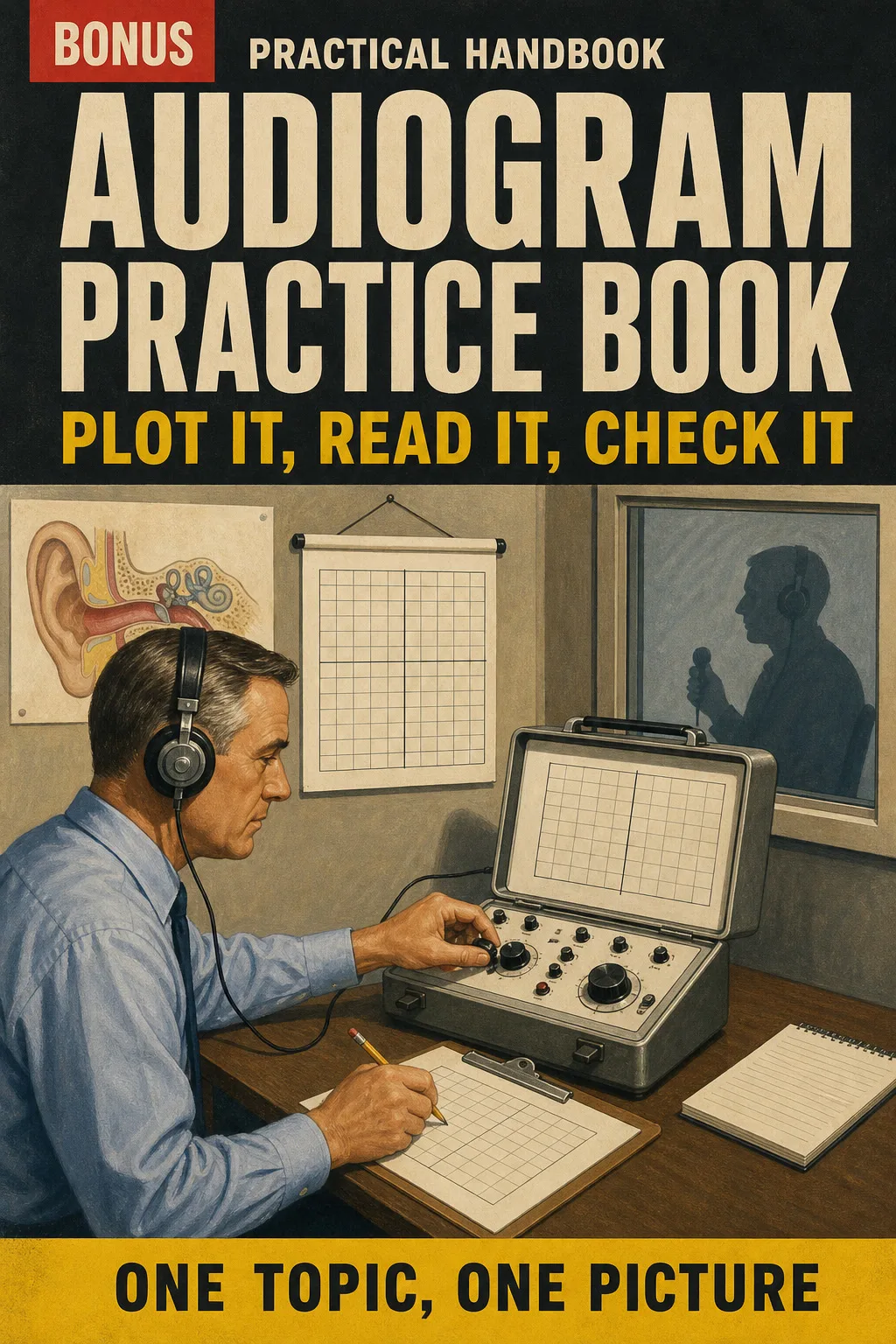
Audiogram Practice Book: Plot It, Read It, Check It

BONUS 1: «Audiogram Practice Book: Plot It, Read It, Check It»

Value on its own: US$ 17.90

Practice plotting and reading audiograms (normal, 4 kHz notch, presbycusis, conductive, mixed) plus exam-style questions, all with answer keys, so you test yourself before the course does.

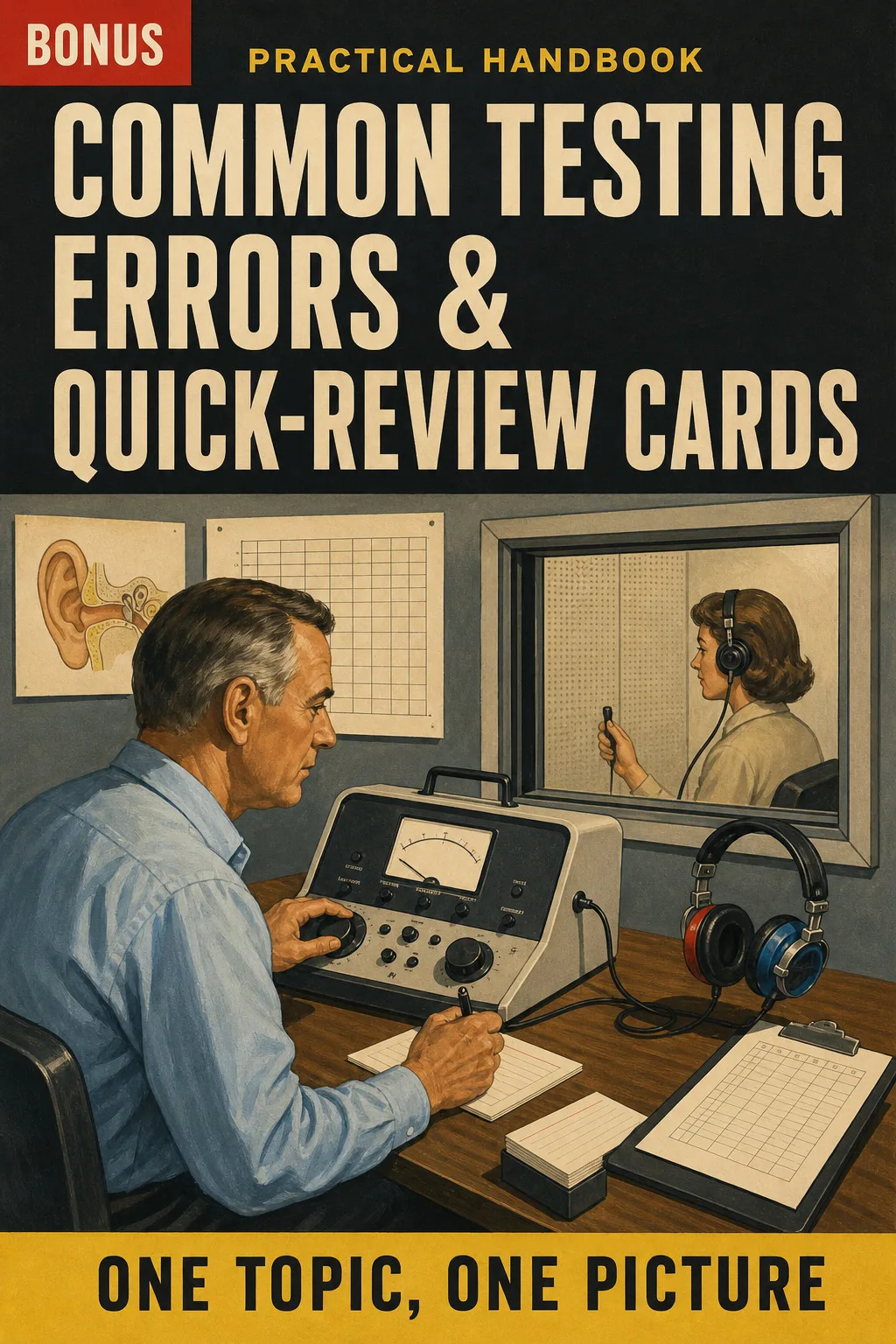
Common Testing Errors & Quick-Review Cards

BONUS 2: «Common Testing Errors & Quick-Review Cards»

Value on its own: US$ 14.90

Each frequent mistake (loose earphones, a red-blue mix-up, testing too fast, forgetting to mask) sits next to the right step, on printable cards you can review in minutes before a test day.

Audiometry Illustrated with 2 Free Books

  • Audiometry Illustrated: 68 illustrated pagesUS$ 63
  • BONUS 1: Audiogram Practice Book: Plot It, Read It, Check ItUS$ 17.90
  • BONUS 2: Common Testing Errors & Quick-Review CardsUS$ 14.90
  • High-resolution PDF to printIncluded
Total value US$ 95.80
YOUR PRICE:
US$ 27
You save US$ 68.80
YES, I WANT AUDIOMETRY ILLUSTRATED FOR US$ 27

📄 This is a digital PDF book sent to your email: nothing is printed or shipped.

Secure purchaseEncrypted payment30-day guarantee

PDF by email: We email you Audiometry Illustrated as a PDF, together with the two free books. It's a single payment: no installments, no extra charges.

Who This Book Is For

You're taking the hearing conservationist course

You're taking the hearing conservationist course

Every step of the pure-tone test drawn in the same order, so the course material finally has something to hang on.

Your course exam is coming up

Your course exam is coming up

Audiograms, symbols, masking and tympanograms one page at a time, with practice audiograms and answer keys. It covers the testing side of the exam, not hearing aid fitting or earmolds.

You already run the annual tests

You already run the annual tests

The STS, the retest and when to refer on a page you can print and keep next to the booth.

Everything You Get Today

US$ 95.80US$ 27
YES, I WANT AUDIOMETRY ILLUSTRATED FOR US$ 27

📄 This is a digital PDF book sent to your email: nothing is printed or shipped.

30DAYS
GUARANTEE

30-Day Guarantee

Try Audiometry Illustrated for 30 days, bonus books included.

We refund everything if the file won't open, if the book isn't what you see here, if you were charged twice or if the email doesn't arrive. Just email us.

You pay once. No subscriptions.

Frequently Asked Questions

Is it for me if I already run screening audiograms?

Yes. It covers the basics in one page each, then goes into masking, the STS, age correction, the OSHA 300 log and when to refer: the parts most people double-check.

Where does the content come from?

It's checked against OSHA 29 CFR 1910.95 (including Appendices B–F), the recordkeeping rule 29 CFR 1904.10 and the ANSI standards S3.6, S3.1 and S3.21.

Is this official material?

No. It's an independent illustrated study guide. It isn't issued or endorsed by OSHA, ANSI, any certifying council or any state board.

Does it replace my course or training?

No. It's study material to go with your course and supervised practice. It doesn't certify you and it isn't a medical diagnosis: hearing concerns always go to an audiologist or physician.

Are the practice questions the ones on the exam?

No. They're written for this book to help you practice. They aren't official questions from any course or exam.

When and how do I get it?

The book and the 2 bonus books come as a PDF by email, to the address you enter at checkout.

Do I have to pay every month?

No. It's a one-time payment. No subscription.

Can I have it on paper?

Yes. It's a printable PDF: print the whole book or just the pages you want next to the booth.

How does the refund work?

You have 30 days. We refund everything if the file won't open, if the book isn't what you see on this page, if you were charged twice or if the email doesn't arrive: just email us.

Before You Close This Page

No more rereading the manual with nothing sticking.

The audiometer panel is drawn and labeled: you see it and you're set.

You walk into the course or the booth knowing where everything is.

Drawings make studying faster.

The book is right below.

One-time payment: US$ 27 · Guarantee: 30 days · PDF by email

YES, I WANT AUDIOMETRY ILLUSTRATED FOR US$ 27

📄 This is a digital PDF book sent to your email: nothing is printed or shipped.